A criminal conviction can have serious and sometimes unexpected consequences under U.S. immigration law. A conviction from many years ago may affect eligibility for permanent residence, a visa, naturalization, certain forms of relief from removal, or even a person’s ability to remain in the United States.
In some cases, obtaining post-conviction relief in criminal court—including an order vacating a conviction—can significantly change the immigration analysis. But the existence of a state-court order labeled “vacated,” “dismissed,” “expunged,” or “set aside” does not automatically mean that the conviction or the underlying criminal matter has disappeared for immigration purposes.
The reason the criminal court granted the relief, what happened to the underlying charges, and what the criminal record continues to establish can all be important.
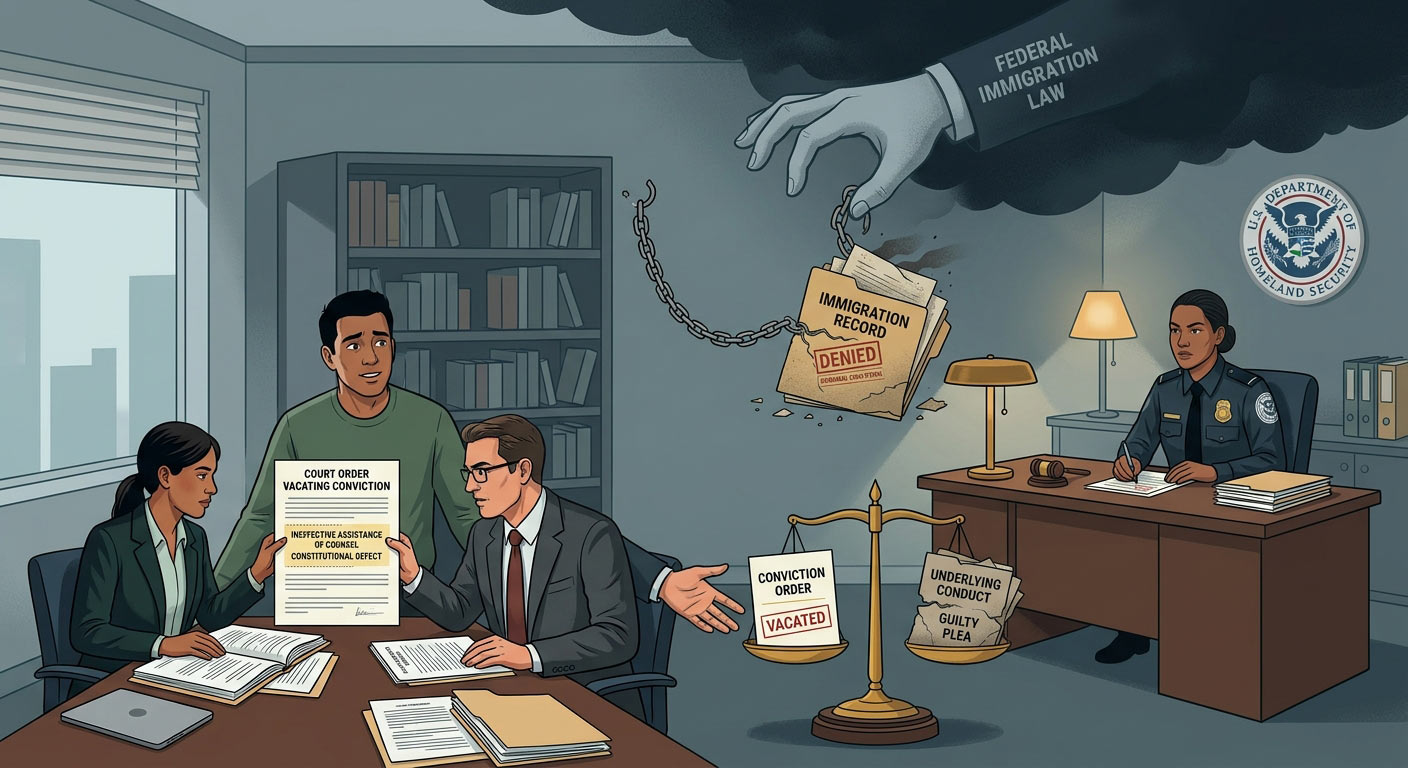
What Does It Mean to Vacate a Conviction?
A vacatur is a court order setting aside a criminal judgment. But describing a vacated conviction as though the criminal case “never happened” can be misleading, particularly in the immigration context.
The effect of a vacatur under state criminal law and its effect under federal immigration law are not necessarily the same. Immigration authorities apply federal immigration law to determine whether the original disposition continues to qualify as a “conviction” under section 101(a)(48)(A) of the Immigration and Nationality Act.
Under that provision, a conviction generally exists when there has been a formal judgment of guilt. Certain deferred adjudications may also qualify as convictions when guilt has been admitted or established and the court has imposed some form of punishment, penalty, or restraint on liberty.
Even when a conviction has been validly vacated and is no longer treated as a conviction for a particular immigration purpose, the underlying criminal case does not necessarily disappear from the immigration record. Depending on the legal issue being decided, immigration authorities may still consider relevant portions of the criminal record, including charging documents, plea and sentencing records, court minutes, and other legally permissible evidence concerning the underlying conduct.
It is also important to determine what happened to the criminal case after the conviction was vacated. An order vacating a judgment does not necessarily mean that the underlying charge was dismissed or that the prosecution cannot proceed again. In some cases, vacating a conviction returns the criminal case to a pre-plea or pre-conviction posture and the charges remain pending. In other cases, the charges may subsequently be dismissed. A dismissal with prejudice, where applicable under state law, may additionally prevent the prosecution from bringing the same charge again.
For immigration purposes, however, whether a prior conviction continues to count is not determined simply by whether the criminal case was dismissed “with prejudice.” The immigration analysis focuses on the nature and legal basis of the post-conviction relief, while the status of the underlying charges and conduct may present separate immigration issues.
For this reason, an immigration analysis should examine the entire post-conviction disposition—not simply an order containing the word “vacated.”
Why Was the Conviction Vacated?
One of the most important questions under immigration law is not simply whether a conviction was vacated, but why it was vacated.
Under longstanding immigration precedent, including Matter of Pickering, a conviction vacated because of a substantive or procedural defect in the underlying criminal proceeding generally will no longer be treated as a conviction for immigration purposes.
By contrast, when a conviction is vacated solely for rehabilitative reasons or to alleviate immigration hardship, immigration authorities may continue to treat the original conviction as valid for purposes of the Immigration and Nationality Act.
Potential defects in the original criminal proceeding may include, depending on the facts and applicable law:
- a constitutionally deficient guilty plea;
- ineffective assistance of counsel;
- failure to provide legally required advice or warnings before a plea;
- violations of constitutional or statutory rights;
- defects in the plea proceedings; or
- other substantive or procedural errors affecting the legal validity of the original judgment.
Whether a particular problem is sufficient to support post-conviction relief depends heavily on the law of the state or jurisdiction where the conviction occurred.
What About Failure to Warn About Immigration Consequences?
This issue frequently arises when a noncitizen entered a guilty plea without understanding that the plea could result in deportation, inadmissibility, or other serious immigration consequences.
In Padilla v. Kentucky, the United States Supreme Court held that the Sixth Amendment requires criminal defense counsel to provide constitutionally adequate advice regarding the risk of deportation associated with a guilty plea.
But Padilla does not mean that every person who was not warned about immigration consequences can automatically have an old conviction vacated.
Among other considerations, the date of the conviction matters because the Supreme Court subsequently held that Padilla does not apply retroactively to convictions that were already final when Padilla was decided in 2010. State constitutions, statutes, court rules, or other grounds for post-conviction relief may nevertheless provide different or additional protections.
A successful ineffective-assistance claim may also require more than showing that counsel’s advice was deficient. Depending upon the applicable law and procedural vehicle, the person may also need to establish prejudice resulting from the deficient advice.
This is one reason post-conviction analysis must be performed under the law of the particular jurisdiction rather than through a one-size-fits-all approach.
Why the Vacatur Motion, Court Order, and Criminal Record Matter
Immigration authorities may examine the basis on which post-conviction relief was granted.
A court order that clearly and accurately identifies a substantive or procedural defect can make the immigration consequences of the vacatur considerably easier to establish. By contrast, an order that simply states that a conviction is “vacated” without explaining why may create additional questions about whether the conviction continues to exist for immigration purposes.
The motion, court order, hearing transcript, applicable statute, court minutes, plea record, and other portions of the criminal proceeding may therefore become important evidence in a later immigration case.
For that reason, immigration consequences should ideally be analyzed before post-conviction relief is sought. Coordination between immigration counsel and qualified criminal or post-conviction counsel can be particularly important.
The objective is not to obtain particular wording merely for immigration purposes. Rather, the court record should accurately identify and document the genuine legal basis upon which relief is being requested and granted.
A Vacated Conviction Does Not Necessarily Erase the Underlying Conduct
This distinction is particularly important.
A successful vacatur may eliminate the immigration-law “conviction” for a particular purpose, but it does not necessarily erase the historical facts of the criminal case, the underlying conduct, or every immigration consequence associated with the incident.
The significance of the underlying conduct depends on the immigration issue being decided.
For example, certain immigration determinations focus on whether a person has a qualifying “conviction” under the INA. Other provisions may focus on conduct, admissions, or other statutory requirements. In discretionary adjudications and certain good-moral-character determinations, underlying conduct may also remain relevant even when the legal status of the conviction has changed.
At the same time, immigration authorities do not necessarily have unlimited authority to use every document in a criminal file for every purpose. The evidence that may properly be considered depends on the particular immigration statute, the legal issue being adjudicated, and the applicable evidentiary framework.
This is why simply obtaining an order stating “conviction vacated” should never be the end of the immigration analysis.
Is a Vacatur the Same as an Expungement or Record Sealing?
Not necessarily.
State criminal laws use terms such as “vacatur,” “expungement,” “dismissal,” “set aside,” and “sealing” differently. The name attached to the procedure does not necessarily determine its federal immigration effect.
For example, a conviction eliminated through a rehabilitative procedure after successful completion of probation may still qualify as a conviction under federal immigration law. Conversely, an order setting aside a conviction because the original proceeding suffered from a substantive or procedural legal defect may have a very different immigration consequence.
Record sealing may restrict public access to criminal records, but it does not necessarily change whether the underlying disposition constitutes a conviction under federal immigration law.
The analysis therefore requires examination of both the state-law procedure and the actual reason relief was granted.
What About Reducing or Modifying a Criminal Sentence?
Sentence modifications present a related but distinct issue.
The immigration consequences of a criminal offense can sometimes depend not only on the offense itself but also on the sentence imposed. Federal immigration law contains specific rules governing the immigration effect of later state-court orders modifying, clarifying, correcting, or vacating a sentence.
Those rules have changed over time, and current federal regulations address the treatment of certain sentence-modification orders as well as orders correcting genuine mistakes or ambiguities.
Accordingly, a sentence-modification strategy should be analyzed separately from a motion seeking to vacate the underlying conviction.
How Can a Valid Vacatur Affect an Immigration Case?
When a conviction is properly vacated on a legally recognized basis, the immigration consequences can be significant.
Depending on the particular offense, the basis for the vacatur, and the immigration benefit or relief involved, post-conviction relief may:
- eliminate a conviction that previously triggered a ground of inadmissibility or deportability;
- remove a statutory obstacle to adjustment of status or another immigration benefit;
- affect eligibility for certain forms of relief from removal;
- materially change the analysis in a pending or future visa or immigration application; or
- affect the criminal-history analysis in a naturalization proceeding.
But a vacatur does not automatically resolve every immigration problem associated with the criminal incident.
A person may still have pending criminal charges. The underlying conduct may remain relevant in certain immigration proceedings. There may be additional convictions or immigration violations. And some immigration provisions turn on conduct or admissions rather than solely on the existence of a criminal conviction.
Naturalization requires particular caution. Even where a prior conviction has been vacated, USCIS may still examine legally relevant underlying conduct when determining good moral character or exercising discretion, depending on the circumstances and applicable statutory period.
What Should a Noncitizen With a Criminal Conviction Do?
The safest approach is to obtain and review the complete criminal record before deciding on a post-conviction strategy.
That record may include the charging document, plea agreement, plea transcript if available, judgment, sentencing documents, court minutes, docket, police or arrest records where relevant to the particular inquiry, and any prior post-conviction motions or orders.
Immigration counsel should then determine exactly why the criminal disposition creates an immigration problem and what would need to change for the proposed post-conviction relief to have a meaningful effect under federal immigration law.
Only then should the appropriate criminal or post-conviction remedy be evaluated under the law of the jurisdiction where the conviction occurred.
This sequencing matters. A disposition that appears extremely favorable under state criminal law may have little or no effect under immigration law. Conversely, post-conviction relief based on a genuine legal defect in the original proceeding may substantially change the immigration analysis even though the historical criminal record does not simply disappear.
The Bottom Line
Vacating a criminal conviction can, in appropriate circumstances, dramatically affect an immigration case. But a state court’s decision to vacate, dismiss, expunge, or set aside a conviction does not automatically make the criminal matter disappear for federal immigration purposes.
The critical questions usually include why the conviction was vacated, what legal authority supported the court’s decision, what happened to the underlying criminal charges, what the criminal and post-conviction records establish, and how federal immigration law treats that particular form of relief.
The most important distinction is this: a successful vacatur may eliminate the immigration-law “conviction,” but it does not necessarily erase the criminal case, the underlying conduct, or every immigration consequence arising from it.
Because criminal and immigration law intersect in unusually complex ways, a noncitizen considering post-conviction relief should ideally have the immigration consequences evaluated before the criminal-court motion is filed.
This article provides general information only and does not constitute legal advice. Criminal and immigration consequences are highly fact-specific and may vary depending on the jurisdiction, date of conviction, criminal statute, procedural history, immigration status, and type of immigration benefit or relief involved. Individuals with criminal records should obtain individualized advice from qualified immigration and criminal/post-conviction counsel.